Constipation is a very common complaint affecting upwards of 15% of all
Americans.
What Is Normal Bowel Function?
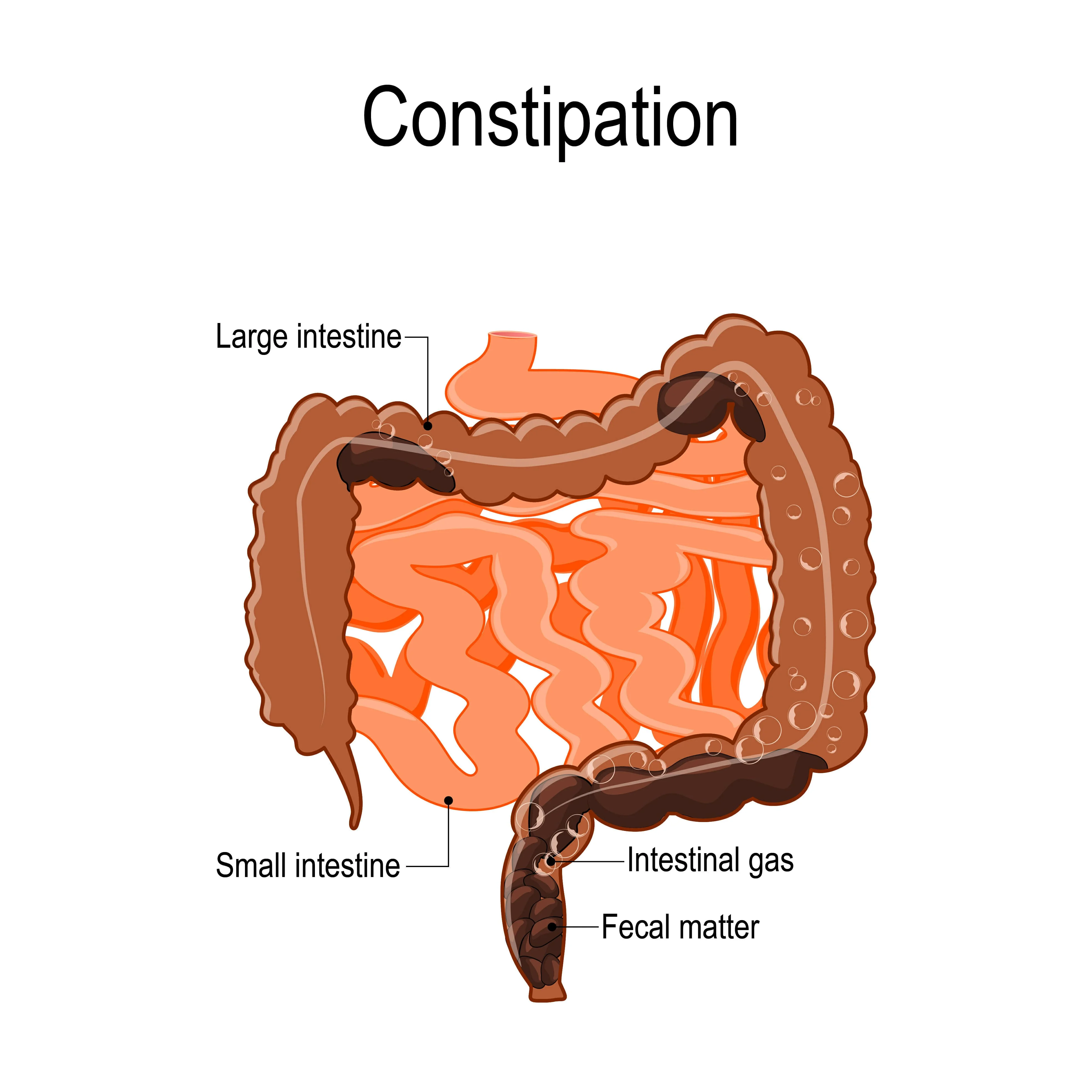
After eating, food is transported through the small intestine, where it
is broken down and the nutrients are absorbed. The remaining liquid
waste then passes into the colon. The colon removes water and certain
electrolytes, turning the liquid waste into a more solid form. It then
passes into the rectum, where it is stored until it is time to have a
bowel movement. Discussion of bowel function can be broken down into
four
Main components:
- Frequency- how often you move your bowels
- Ease of evacuation of stool- is there a need to strain
- Firmness of stool- how hard is the stool
- Sense of complete evacuation of stool- do you feel stool is stuck in the rectum
There is a wide range of what are considered “normal” bowel habibowel
movements should occur at least every 1-3 days and nomore than three
times per day. Stool should pass easily and not require excessive
straining. Lastly, one should experience a sense of completeness of
elimination.
Defining Constipation
Given the four main components of bowel function described above,
constipation may mean different things to different persons. For some,
constipation may mean infrequent bowel movements. To others, it is a
hard stool which may be difficult to pass and requires excessive
straining. Lastly, constipation may mean a bowel movement which does not
completely evacuate and leaves the person with a sense that they still
“need to go.” Some patients have combinations of these symptoms.
In an effort to better define constipation, specific criteria were
established by the ROME Multinational Consensus in 2000, and
subsequently updated last in 2016:
- Less than three bowel movements per week
- Straining more than 25% of the time
- Hard stools more than 25% of the time
- Incomplete evacuation or sense of blockage more than 25% of the time
- Need to use your hand to pass the bowel movement at least 25% of the time
It is important to keep in mind that constipation must be differentiated
from irritable bowel syndrome, constipation subtype (IBS-C) which is
associated with abdominal pain, irregular bowel habits (intermittent
loose stools not associated with laxatives), and pain relieved by
defecation.
What Causes Constipation?
Causes of constipation include:
- Lack of dietary fiber
- Sedentary lifestyle
- Dehydration
- Medical conditions – e.g., hypothyroidism, diabetes, scleroderma, lupus, depression
- Medications – e.g., narcotic pain medications, blood pressure medications, and psychiatric medications
- Abnormal function – colonic inertia, pelvic floor muscle dyssynergia, Hirschsprung’s disease
- Colon or rectal cancer
- Anal cancer
- Anatomic reasons -enterocele, sigmoidocele, rectocele, and rectal intussusception, or prolapse
- Colonic stricture or narrowing caused by diverticulitis, Crohn’s disease, radiation induced, and ischemia
How Do You Treat Constipation?
Generally, constipation is avoided by following the basics of good
intestinal health. Diet, fluid intake, and physical activity should
always represent the initial steps when an individual experiences
constipation.
Fiber
Twenty-five to thirty-five grams of fiber per day is the
recommended daily amount of dietary fiber. Eating a diet rich in whole
grain breads, cereals and fiber bars, in addition to fresh fruits and
vegetables, often will improve bowel habits by adding bulk to the stool.
Fiber and fiber supplements, however, are not an antidote for poor
dietary habits, such as eating fried or fatty foods and frequent red
meat. Healthy dietary choices are the foundation of intestinal health
and bowel function.
Water
Scientific studies have shown that drinking 6 to 8 glasses of
water per day (1.5-2 liters) will help keep the stool from being hard
and makes iteasier to eliminate. Regular exercise, which can be as
simple as taking a brisk walk for 30 minutes per day, will likely
improve bowelmovements as well.
ROLE OF LAXATIVES
There are many different types of over-the-counter laxatives available.
The way in which laxatives work varies and can be very effective for
acute relief of constipation and, in rare cases, may be part of a
regular routine. Before one resorts to routine laxative use, it is
important to discuss your symptoms with your medical provider, as a more
serious medical condition may need to be ruled out.
Irritant-type laxatives (cathartics) stimulate bowel wall contraction.
Examples of this class of laxatives include senna, cascara sagrada, or
bisacodyl-based medications. The long term use of such stimulant
laxatives may result in tolerance and over time, bowel function may
become ineffective. Chronic use is generally discouraged.
Another class of laxatives are the osmotic-type laxatives which promote
water retention in the bowel. These laxatives may be based on salts or
sugars as the active molecules creating the osmotic effect (pulling
water into the colon). Sugars such as lactulose or sucrose are
available. Magnesium-based (Milk of Magnesia®, magnesium supplements)
products can also act as osmotic laxatives, although care must be
exercised in patients with kidney problems, as such types of laxatives
may cause electrolyte problems in patients with kidney disease.
Polyethylene glycol 3350 (MiraLAX®) is an over-the-counter osmotic
laxative which increases bowel frequency and is commonly recommended as
a result of its safety.
Other laxatives improve passage of stool by affecting the character of
the fecal material. Mineral oil prevents fluid loss by coating the
stool. Docusate sodium (Colace®) enhances water penetration into the
stool, making it softer and is not a true laxative.
Enemas and suppositories also have been used to treat constipation.
Enema and suppository therapy stimulate defecation through distension of
the rectum (saline) or by irritation (soap suds, Fleets®, bisacodyl) or
by softening the stool (glycerin suppository). Unfortunately, a downside
of such a strategy is that it can be habit forming, and tolerance to
such stimulation may diminish effectiveness long term.
Again, it must be stressed that while laxatives, enemas, and
suppositories may all play a role in the treatment of constipation,
their chronic use should be discouraged without first consulting with
your medical provider to ensure that a more serious condition is not
overlooked.
Specific Medications to Treat Constipation
Specific medical therapies exist to treat constipation. These therapies
are prescribed by your medical provider only in certain circumstances,
and cost may be an issue. One available medication is lubiprostone
(Amitiza®). This medication works by increasing intestinal secretion.
While this medication is safe, the side effects include diarrhea,
nausea, and headaches, which may limit its effectiveness. Linaclotide
(Linzess®) is approved by the U.S. Food and Drug Administration as a
medical therapy for constipation. This drug works by increasing both
motility and by increasing intestinal secretion. Another medication
approved in Europe and Canada for the treatment of constipation in
females, prucalopride (Resolor®, Resotran®), works by increasing bowel
motility. Unfortunately, the number of males studied was insufficient to
demonstrate benefit in this group. Currently, prucalopride has not yet
been approved for use by the U.S. Food and Drug Administration but
offers a possible future treatment option. Another medication which
treats constipation specific to individuals taking chronic narcotic pain
medications due to chronic pain resulting from advanced illness is
methylnaltrexone bromide (Relistor®) and Naloxegol (Movantik®). These
have been approved for opioid-induced constipation (OIC) and works by
counteracting the negative effects of narcotic pain medications on bowel
motility. This again requires medical evaluation and a prescription.
Cost will be an issue for those whose medication benefit plan does not
cover this relatively new drug.
Associated Symptoms and When to Seek Help
Knowing when constipation requires professional evaluation is key. In
general, if constipation becomes progressive either in frequency or
severity and not manageable with the simple measures described above,
one should seek medical attention. Constipation often is accompanied by
other symptoms which can be very important in terms of determining the
nature of the problem and knowing when you should see a medical
provider. Not infrequently, constipation is associated with a bloating
sensation, mild nausea, and perhaps mild cramping pain, all of which are
generally relieved by bowel movements. Clearly, if one has worsening
nausea and repeated vomiting or if abdominal pain becomes severe and
constant, one should seek immediate help. Also, if constipation is
associated with a change in stool size — narrow like a pencil or
ribbon — change in stool frequency, or if any blood is seen, one
should see a medical provider.
How Do You Evaluate Constipation?
There are several tests that could be considered when constipation
persists in spite of basic measures or if the constipation is associated
with other symptoms.
Diagnostic studies to evaluate constipation include:
Colonoscopy
Barium enema
CT colonography (virtual colonoscopy)
Colonic transit study (Sitzmarks® study)
Anorectal manometry
Defecography – fluoroscopic (traditional) or dynamic MRI
Colonoscopy
Colonoscopy is a test where a lighted flexible tube with a video
camera at its tip is passed through the anus, rectum, and colon,
allowing for visualization of the lumen of the bowel and inspection for
growths such as polyps or masses. Colorectal cancer is common in the
U.S. and should always be high on the list for possible causes of
blockage of the colon and a potential cause of constipation. Colonoscopy
has the advantage of patient sedation and is generally better tolerated
as a result. Colonoscopy should not be performed when acute
diverticulitis is suspected due to the risk of perforation. Colonoscopy
has a very small risk (about 1 in 1,000) of perforating the colon or
causing bleeding severe enough to require a blood transfusion and/or
surgery. It is the most sensitive test, however, for detecting polyps
(precancerous growths), allows for removal of such polyps, and allows
for biopsy of any other lesions detected.
Barium enema
Barium enema is an x-ray test involving passage of an enema
containing contrast into the rectum and colon with subsequent multiple
abdominal x-rays performed, providing information related to the bowel
lumen and the presence of masses or narrowing of the lumen. It is less
commonly performed than colonoscopy, but may be complementary to
colonoscopy when evaluating narrowing of the bowel due to scarring.
Disadvantages of a barium enema are that it again requires bowel
cleansing, is performed in the awake patient, is not as sensitive at
detecting polyps, and, if abnormal, requires subsequent colonoscopy to
be performed for further evaluation.
virtual colonoscopy
A special CT scan of the abdomen and pelvis (CT colonography) or
“virtual colonoscopy” may also be considered as an alternative
radiology study, but just as in the case of an abnormal barium enema, a
colonoscopy would then be necessary if abnormalities were found. So,
while there are options, diagnostic colonoscopy generally is considered
the initial test of choice in a person with symptoms of constipation.
Rarely, severe constipation occurs due to lack of colonic muscular
activity and failure to push stool to the rectum. This condition, known
as colonic inertia, results in profound constipation where patients
often may fail to have a bowel movement for weeks. Such constipation
often develops in childhood, although not always. This may represent as
few as ten percent of all patients presenting to medical attention for
the evaluation of constipation. The cause of colonic inertia is unknown.
Evaluation involves colonoscopy or barium enema to assess for mechanical
blockage. If no blockage is found, the colon’s ability to propel stool
can be determined by a colonic transit study where a patient
swallows a capsule (Sitzmarks ®) with small rings which can be seen on
x-ray and followed by serial x-rays to assess the progress of the rings
passing through the intestinal tract. In the simplified method, one
capsule is ingested on Sunday and x-rays of the abdomen are performed on
Monday, Wednesday and Friday. Usually, all the rings are expelled by the
fifth day. An abnormal study is identified by 6 of 24 rings (>20%)
remaining within the intestinal tract and there are two particular
patterns which may be present. If more than 20% (6 or more) of the
markers remain and are distributed throughout the colon, the study
suggests colonic inertia or poor muscular activity of the colon and the
failure of the colon to propel the stool (Figure 3). If more than 20% of
the markers remain, but are pushed to the rectum and not expelled, this
would suggest normal muscular activity of the colon, but indicate that
there is a problem with the muscles of the pelvic floor (Figure 4). This
would be referred to as dyssynergic defecation or pelvic outlet
dysfunction syndrome (ODS). The pelvic floor muscles may fail to relax
in a coordinated fashion (i.e pelvic floor dysfunction, pelvic
dyssynergia, non-relaxing puborectalis muscle) to allow for evacuation.
There may be an anatomic abnormality which inhibits or blocks normal
evacuation such as an enterocele, sigmoidocele, rectocele, or rectal
prolapse.
Anal manometry
Pelvic floor function can be assessed on physical exam by assessing the
ability of the anal sphincter and pelvic floor muscles to squeeze and
relax normally. To confirm possible disorders of the anal sphincter
muscles or pelvic floor function, a study called “anal manometry”
can be performed to measure the pressures of the muscles at rest and
when functioning. Anal manometry should be considered to evaluate for
outlet obstruction when a patient feels that the rectum is distended and
the desire to eliminate is present, but upon attempts to evacuate, the
patient fails to do so. This suggests possible pelvic or anal outlet
obstruction as the cause of constipation. Manometry is done by inserting
a thin tube into the anal canal and rectum and measuring pressures with
various maneuvers. The test measures pressures at rest, upon voluntary
squeeze, and with attempt to evacuate. In addition, a small balloon on
the tip of the catheter can be inflated to assess sensation of rectal
filling. Again, normal bowel function requires the ability to sense when
the rectum is filling and stretching out. Balloon inflation also tests
an important reflex of the anal sphincter muscles. Typically, during
rectal filling and distension – simulated by the inflation of the
balloon – we normally expect that measured pressures will briefly
decrease in the anal canal. This reflex is known as the recto-anal
inhibitory reflex and absence of this reflex may indicate failure of
relaxation of the sphincter muscles to allow for evacuation. Both
Chagas’ disease (caused by a parasite, usually found in Brazil) and
Hirschsprung’s disease (a developmental absence of nerve endings in the
anal sphincter muscle) result in failure of the anal sphincter muscles
to relax and, thus, not allow for normal passage of stool out of the
rectum.
Additionally, anal manometry may identify contraction instead of
relaxation of the pelvic floor muscles during an attempt to evacuate,
which may represent loss of the normal coordinated reflex. This failure
of relaxation of the pelvic floor muscles again results in an inability
to eliminate stool. During anal manometry, a balloon expulsion test can
be performed. The catheter balloon is filled to 60 milliliters and the
patient is instructed to evacuate the balloon. If the patient is unable
to eliminate the balloon within one minute, the test is abnormal and
suggests an anal or pelvic floor outlet dysfunction as the cause for
constipation.
Defecography is an additional x-ray test utilized to evaluate the
patient’s ability to eliminate stool properly. This involves drinking
barium by mouth to fill the small intestine and inserting an enema of
thick barium or paste (about the consistency of oatmeal) into the
rectum. The patient then sits on a special commode and fluoroscopy
(dynamic x-rays) is performed during a patient’s attempt to evacuate the
paste from the rectum. This enables evaluation of the coordinated
movement of the rectum and pelvic floor muscles to allow for evacuation
of the rectum as well as to evaluate for possible anatomic abnormalities
which may inhibit or block elimination. A variant of this test is a
dynamic MRI.
In addition to identifying cases where the pelvic floor muscles do not
relax normally during evacuation (pelvic dyssynergia), other anatomic
abnormalities may also be discovered. An enterocele is a type of hernia
at the pelvic floor where the small intestine pushes between the vagina
and the rectum, thereby occluding the rectum during defecation.
Similarly, a sigmoidocele occurs when the sigmoid colon descends into a
pelvic floor defect and obstructs the rectum. Intussusception of the
rectum or rectal prolapse can also cause occlusion by internally
blocking the rectum. A rectocele is an outpouching of the rectum into
the posterior wall of the vagina which will “pocket stool” and prevent
normal passage of stool downward and out. These abnormalities are
visualized by defecography. Identification of such abnormalities leads
to careful selection of patients who may benefit from surgical repair
and correction.
Treatment of Severe Constipation and Specific Disorders
In the case of pelvic floor non-relaxation (pelvic floor muscle
dyssynergia), physical therapists can help patients retrain using
special techniques (biofeedback) to improve sensation of rectal fullness
as well as pelvic muscle relaxation to allow for elimination.
The objectives of biofeedback are two-fold: To correct the dyssynergia
or incoordination of the abdominal, rectal, puborectalis and anal
sphincter muscles in order to achieve a normal and complete evacuation
and, secondly, enhance rectal sensory perception (rectal filling or
distension) in patients with impaired rectal sensation. The regimens for
therapy vary, but a training session typically takes one hour. Patients
usually undergo therapy everyone to two weeks and on average, four to
six training sessions are required. Subsequent reinforcements at six
weeks, three months, six months and twelve months may provide additional
benefit and also improve the long-term outcome for these patients, but
its efficacy has not been validated.
The results of biofeedback range depending upon the measured endpoints.
Several randomized controlled trials of adults with dyssynergic
defecation have been reported. While the studies differ in respect to
their methods, all of these studies have concluded that biofeedback
therapy is superior to controlled treatment approaches such as diet,
exercise, laxative use, and other therapies. Identifying patients with
dyssynergic defecation likely can lead to relief of constipation with
biofeedback. Unfortunately, such therapy appears limited by the presence
in medical communities of trained physical therapists dedicated to
pelvic floor disorders.
Surgery:
Constipation is a problem rarely treated with surgery, but removing the
colon for slow transit constipation may be considered. Patients
considered for surgical correction of constipation should be thoroughly
evaluated to ensure no evidence of dyssynergic defecation and verify
normal stomach emptying and small intestinal transit by a physician and
undergo appropriate testing. These patients should also have failed
maximal medical management.
Colonic inertia or slow transit constipation refers to a lack of normal
movement of stool through the colon and results in infrequent bowel
movements. The operative procedure to treat slow transit constipation
involves removal of the colon (total abdominal colectomy - TAC) with
either reconnection of the small intestine to the rectum (ileorectal
anastomosis- IRA) or, alternatively, creation of an end ileostomy
(intestine brought out through the abdominal wall and skin to empty into
a bag). The procedure often can be performed using a laparoscopic
technique involving camera-guided surgery, small instruments, small
incisions, less pain, faster recovery, and quicker return to regular
activities. After TAC
with IRA, the patient should expect to have multiple (3-5) loose stools
per day. Although constipation is reliably relieved by TAC with IRA,
significant issues remain regarding a patient’s sense of the quality of
life and satisfaction associated with this treatment.
TAC with IRA can be associated with abdominal pain, diarrhea,
incontinence, and recurrence of constipation. Patients should be
counseled that
the abdominal pain and bloating may persist postoperatively even after
normalization of bowel frequency. A specific group of patients
vulnerable to poor outcomes following TAC with IRA are patients who
suffered prior sexual abuse. These patients, in particular, require more
post-colectomy medical care for abdominal complaints. Thus, prior to
surgery for colonic inertia, patients should be extensively counseled
about the risk of persistence of symptoms and the potential for
development of new symptoms after surgery.
As previously discussed, pelvic floor hernias and rectocele of the
rectum can be repaired when identified on defecography.
Lastly, specific diseases which have narrowed the bowel due to
inflammation (diverticulitis, Crohn’s disease, ulcerative colitis,
ischemic colitis) or due to
colorectal cancer will require surgery.
It is very important to emphasize that the role of surgery in the
treatment of constipation is for very specific diseases or disorders.
The reality is that patients with constipation will rarely require an
operation. Referral to a colon and rectal surgeon should be viewed as an
opportunity to have an expert evaluate a patient in the most efficient
and logical manner, hopefully resulting in an effective and rational
treatment of constipation.
Summary
Constipation is a common complaint which is most often avoided or
addressed by thoughtful dietary choices to increase fiber and fluid
intake and by lifestyle changes to include regular exercise. If these
measures fail to improve your bowel habits, talk to your doctor or
medical provider to be evaluated. Laxatives should not be regularly
taken without first talking to your medical provider. Lastly, if
constipation is associated with symptoms such as nausea and vomiting,
acute abdominal pain, or blood from the rectum, one should immediately
seek medical attention to evaluate the cause of the complaints. Medical
management is usually effective in relieving symptoms, while surgery is
reserved for very specific
situations and gives good results in the right patient.