This page provides educational hemorrhoid images, real clinical pictures, and medical illustrations related to hemorrhoids. Visual guides can help patients better understand the anatomy of hemorrhoids, the difference between internal and external hemorrhoids, what thrombosed hemorrhoids may look like, and how various treatments work.
These images and diagrams are intended for educational purposes and may help explain symptoms, diagnosis, and treatment options. Some clinical images may be graphic. Pictures can be helpful, but they cannot confirm a diagnosis or replace an examination by a colorectal specialist.
What Do Hemorrhoids Look Like?
Internal hemorrhoids develop inside the rectum, while external hemorrhoids form under the skin around the anus.
Hemorrhoids can look different depending on whether they are internal, external, thrombosed, or prolapsed. External hemorrhoids may look like swollen tissue or one or more lumps around the anus. Internal hemorrhoids are usually not visible from the outside unless they prolapse through the anus.
A visual guide can help patients understand common appearances, but pictures alone cannot confirm the diagnosis. Anal fissures, skin tags, abscesses, warts, rectal prolapse, inflammatory bowel disease, and tumors may sometimes be confused with hemorrhoids.
Real Pictures of Hemorrhoids vs Medical Diagrams
Real pictures of hemorrhoids can help patients understand the appearance of external hemorrhoids, thrombosed hemorrhoids, and prolapsed hemorrhoids. However, real clinical photos can vary widely based on skin tone, swelling, lighting, thrombosis, ulceration, prolapse, and image quality.
Medical diagrams are often more useful for understanding where hemorrhoids occur, why symptoms develop, and how treatment options work. Real hemorrhoid pictures may show more detail, but they should not be used to self-diagnose rectal bleeding, anal pain, or a new lump.
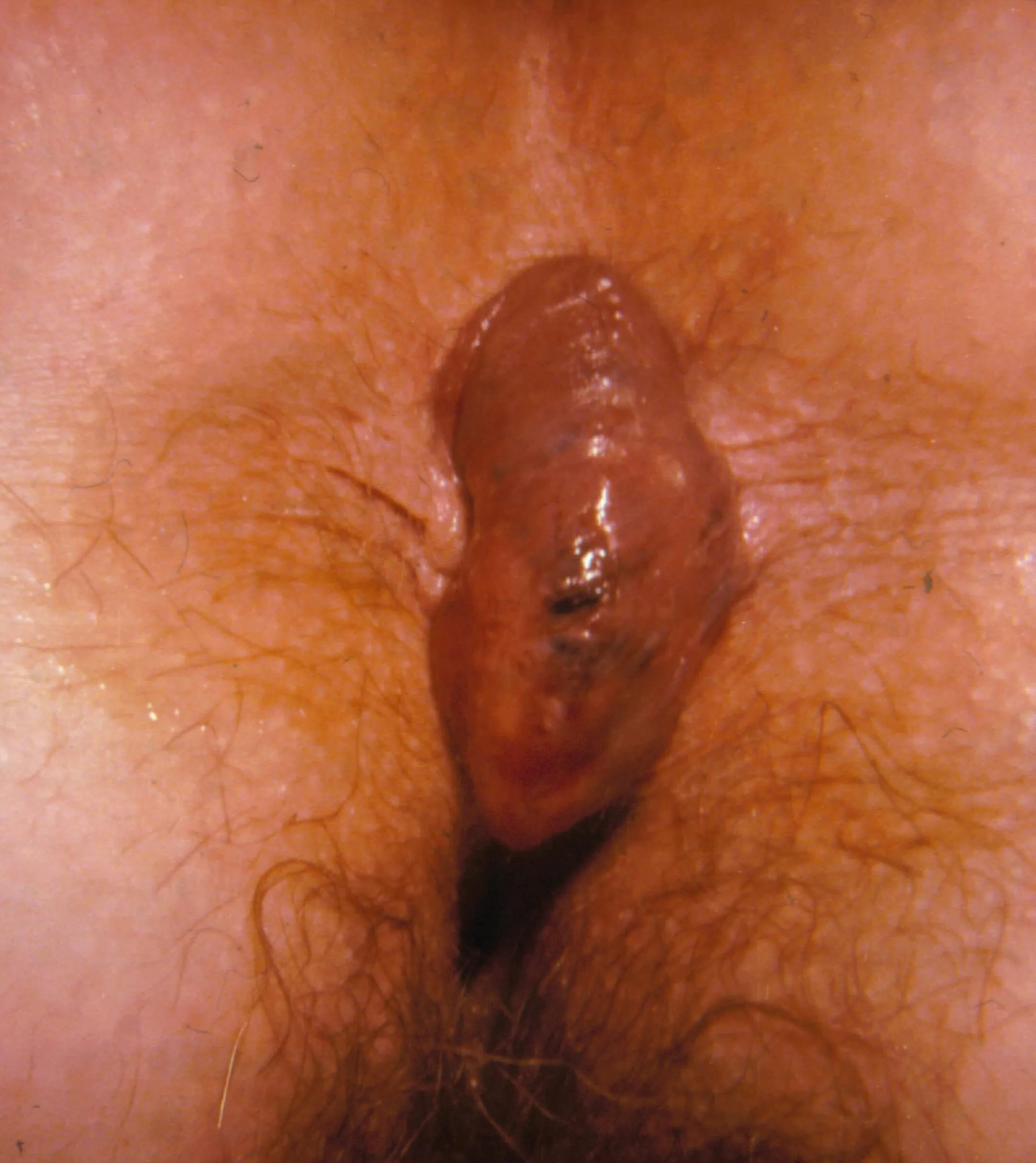
Thrombosed External Hemorrhoid Real Picture
Clinical image showing a thrombosed external hemorrhoid with ulceration. Image courtesy of ASCRS U Image Library.
Clinical image courtesy of ASCRS U Image Library.
This real picture shows a thrombosed external hemorrhoid with ulceration. A thrombosed external hemorrhoid occurs when a blood clot forms inside an external hemorrhoid. This can cause sudden pain, swelling, firmness, and a bluish, purple, or dark area near the anus.
External Hemorrhoids Pictures
Clinical image showing a large thrombosed external hemorrhoid. Image courtesy of ASCRS U Image Library.
Clinical image courtesy of ASCRS U Image Library.
External hemorrhoids occur under the skin around the anus. They may appear as small swollen areas, soft bumps, or tender lumps near the anal opening. External hemorrhoids are more likely to cause pain, swelling, itching, irritation, or discomfort with sitting and bowel movements.
A thrombosed external hemorrhoid occurs when a blood clot forms inside an external hemorrhoid. This may appear as a painful, swollen, firm lump that can look bluish, purple, red, or dark.
Small External Hemorrhoids Pictures
Small external hemorrhoids may appear as mild swelling or a small lump near the anus. They may cause itching, burning, irritation, or discomfort, especially with constipation, prolonged sitting, wiping, or straining.
Mild symptoms may improve with conservative care such as increasing dietary fiber, drinking adequate fluids, avoiding prolonged straining, and using warm sitz baths. Persistent symptoms should be evaluated to confirm the diagnosis and rule out other anorectal conditions.
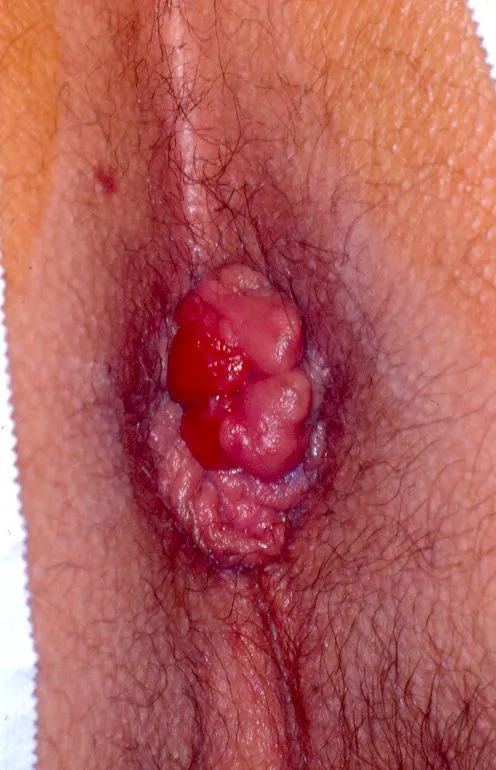
Prolapsed Hemorrhoids Pictures
Clinical image showing a fourth-degree prolapsed hemorrhoid. Image courtesy of ASCRS U Image Library.
Clinical image courtesy of ASCRS U Image Library.
Prolapsed hemorrhoids occur when enlarged internal hemorrhoidal tissue bulges outside the anus. Prolapse may happen during bowel movements and may go back in on its own, require manual reduction, or remain outside the anus.
A fourth-degree hemorrhoid is a severe prolapsed hemorrhoid that remains outside the anus and cannot be manually reduced. Prolapsed hemorrhoids can cause bleeding, mucus drainage, irritation, pressure, hygiene difficulty, or the sensation of tissue coming out during bowel movements.
Female Hemorrhoids Pictures and Symptoms
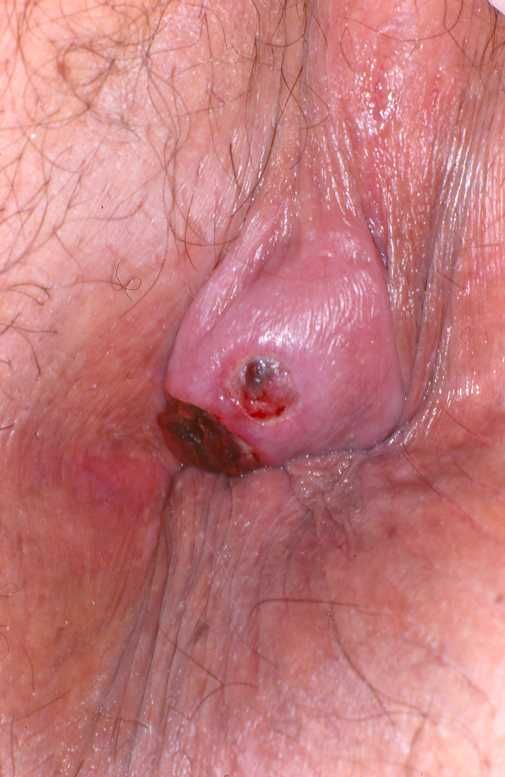
Clinical image showing a thrombosed external hemorrhoid with ulceration. Image courtesy of ASCRS U Image Library.
Clinical image courtesy of ASCRS U Image Library. This image is included for educational comparison only; hemorrhoids in women and men can look similar, and pictures should not be used to confirm a diagnosis.
Hemorrhoids in women generally look similar to hemorrhoids in men. They may appear as external swelling, a tender lump near the anus, prolapsed internal tissue, or a thrombosed external hemorrhoid.
Pregnancy, childbirth, constipation, prolonged straining, and pelvic pressure may contribute to hemorrhoid symptoms in some women. However, rectal bleeding, persistent pain, or a new anal lump should not be self-diagnosed from pictures alone.
Internal vs External Hemorrhoids
Internal hemorrhoids develop inside the rectum, while external hemorrhoids occur under the skin around the anus. Internal hemorrhoids often cause painless bleeding, while external hemorrhoids may cause pain, swelling, or itching.
Thrombosed Hemorrhoid
A thrombosed hemorrhoid occurs when a blood clot forms inside an external hemorrhoid. This can cause sudden pain and swelling near the anus.
Hemorrhoid Prolapse Grades
Internal hemorrhoids are classified into four grades based on prolapse, but treatment also depends on bleeding, discomfort, hygiene problems, and the effect on daily activities.
Internal hemorrhoids are classified into four grades depending on how much they prolapse outside the anus.
Grade I – no prolapse
Grade II – prolapse during bowel movements but retract spontaneously
Grade III – require manual reduction
Grade IV – permanently prolapsed
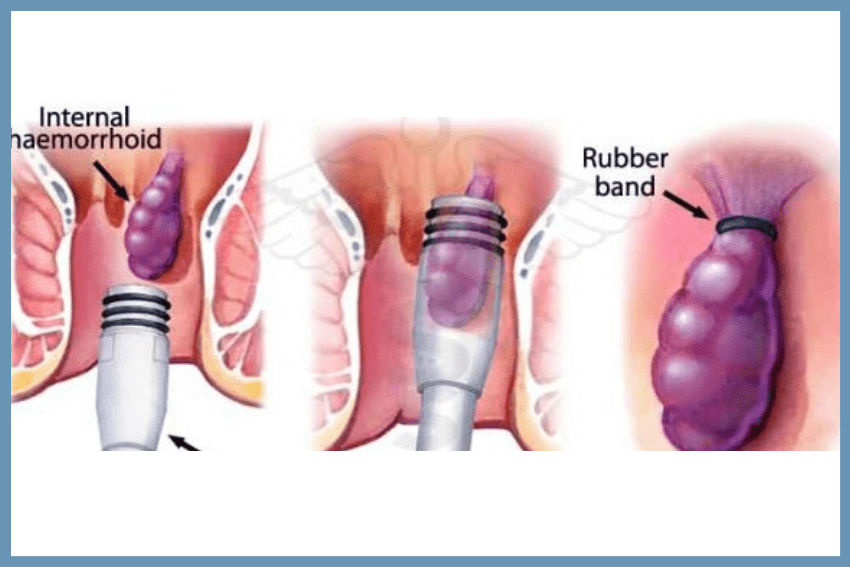
Rubber Band Ligation Procedure
Rubber band ligation is a common office procedure for internal hemorrhoids.
Rubber band ligation is a common office procedure used to treat internal hemorrhoids. A small band is placed around the hemorrhoid to cut off blood supply, causing the hemorrhoid to shrink and fall off.
Stapled Hemorrhoidopexy Procedure
Stapled hemorrhoidopexy is a surgical procedure used to reposition prolapsing internal hemorrhoids and reduce blood flow to the hemorrhoidal tissue.
Stapled hemorrhoidopexy is a surgical procedure used to treat prolapsing internal hemorrhoids. During this procedure, a specialized circular stapling device is used to reposition the hemorrhoidal tissue back into its normal position and reduce blood flow to the hemorrhoids. This helps shrink the hemorrhoids and relieve symptoms such as bleeding and prolapse.
This procedure is typically recommended for Grade III or Grade IV internal hemorrhoids, particularly when significant prolapse is present.
Hemorrhoidectomy Surgery
Hemorrhoidectomy is a surgical procedure used to remove large or severe hemorrhoids when other treatments are not effective.
Hemorrhoidectomy is a surgical procedure used to remove large or severe hemorrhoids. It is usually recommended when hemorrhoids cause persistent symptoms such as bleeding, pain, or prolapse that do not respond to conservative treatments or office-based procedures.
During a hemorrhoidectomy, the surgeon removes the enlarged hemorrhoidal tissue, providing a long-term solution for severe hemorrhoids. Although recovery may take longer than with office procedures, hemorrhoidectomy is considered one of the most effective treatments for advanced hemorrhoids.
When to See a Colorectal Surgeon
You should seek medical evaluation if you have rectal bleeding, severe anal pain, sudden painful swelling, a new or enlarging lump near the anus, drainage, fever, prolapsed tissue that does not go back in, or symptoms that do not improve with conservative treatment.
Hemorrhoid pictures can help with education, but they should not replace a medical examination. A colorectal surgeon can confirm the diagnosis and recommend treatment based on symptoms, examination findings, hemorrhoid type, and severity.
If you are concerned about hemorrhoids, rectal bleeding, anal pain, or a new lump near the anus, you can schedule an appointment with Dr. Aisha Akhtar, MD, a board-certified colorectal surgeon in Phoenix, Arizona.
Learn what internal, external, prolapsed, and thrombosed hemorrhoids look and feel like. Compare common symptoms and know when to seek medical evaluation.
Learn how hemorrhoids are treated including lifestyle changes, medications, office procedures, and surgery. Understand which hemorrhoid treatments work best.
Learn how to treat hemorrhoids at home using diet changes, fiber, sitz baths, and other remedies that can relieve pain, itching, and swelling.
Expert Colorectal Care
Expert Hemorrhoid Care in Phoenix
Dr. Aisha Akhtar, MD is a board-certified colorectal surgeon specializing in the evaluation and treatment of hemorrhoids and other anorectal conditions. She offers comprehensive care ranging from conservative management to office procedures such as hemorrhoid banding and advanced surgical treatments when necessary.
“The whole office was wonderful. Dr Akhtar was excellent. She was thorough. She explained things extremely well. She answered all my questions. I...The whole office was wonderful. Dr Akhtar was excellent. She was thorough. She explained things extremely well. She answered all my questions. I never felt like she was rushing my exam.”
Jaime Peters
★★★★★
“Dr. Akhtar and the entire team made what could have been a very stressful experience feel comfortable, reassuring, and genuinely cared for from sta...Dr. Akhtar and the entire team made what could have been a very stressful experience feel comfortable, reassuring, and genuinely cared for from start to finish. Dr. Akhtar was professional, compassionate, and took the time to thoroughly explain everything before my procedure, which immediately put me at ease. The procedure itself went smoothly, and I truly felt I was in excellent hands the entire time. The office staff was also kind, organized, and attentive throughout the process. I’m incredibly grateful for the level of care, patience, and professionalism I received. I would absolutely recommend Dr. Akhtar to anyone looking for a skilled doctor who truly cares about their patients and their comfort.”
Michelle Abby
★★★★★
“I cannot express the how thankful I am for Dr. Akhtar. I had been to 4 other colorectal doctors, 3 gastro doctors before seeing Dr. Akhtar. I was c...I cannot express the how thankful I am for Dr. Akhtar. I had been to 4 other colorectal doctors, 3 gastro doctors before seeing Dr. Akhtar. I was crying in her office when she met me the first time. That didn't deter her. Not only that but she located the issue on my first visit. She is kind, caring, thorough and incredibly knowledgeable. She listens, spends time with you and doesn't talk over you. I've needed extra time to discuss my case many times and she has always taken the time that I needed. I've brought to her research I've read, and she always already knows about the publications. The staff are kind and helpful. I dont know what I would have done without finding her. Another health care provider recommended her highly as do I.”
Lorena Zeilman
★★★★★
“Best colorectal surgeon I’ve ever met. Dr. Akhtar is compassionate, gentle, warm, and caring. I came to her in Glendale after having a horrific exp...Best colorectal surgeon I’ve ever met. Dr. Akhtar is compassionate, gentle, warm, and caring. I came to her in Glendale after having a horrific experience with a general surgeon in Flagstaff (where I live). The Flagstaff surgeon caused a hemorrhage that almost cost me my life, and then I developed stenosis after the emergency room surgeon “fixed” the hemorrhage. Dr. Akhtar was kind enough to take me as a patient (most surgeons will not take a patient who has already been operated by another surgeon due to liability). She was very respectful and gentle in the examination, and was even able to fit me in for an outpatient procedure under sedation the very same day (knowing that I drove over 2 hours to see her). I could not be happier with her. She took the time to personally call me the next day to check on my progress. You do not see this type of doctor very often anymore. She is someone who is in it for the patient, and you can tell. I will continue to drive over 4 hours there and back to receive her high quality care and expertise. Cannot recommend her highly enough.”
Brianna Stabler
★★★★★
“Dr. Akhtar is THE BEST provider I have ever seen, period. She is incredibly knowledgeable, informative, and above all so kind. I have not met...Dr. Akhtar is THE BEST provider I have ever seen, period. She is incredibly knowledgeable, informative, and above all so kind. I have not met many people who have as comforting a bedside manner as she does. I was educated properly every step of the way and felt confident doing so because of her caring demeanor. Her PA Moses is also so friendly and upbeat, helping to ease any tension you may be feeling prior to the exam. The energy both Dr. Akhtar and Moses bring was paramount to how excellent my experience was here. Given their specialty, it would be easy to have an uncomfortable experience. However, they go the extra mile to make sure you are comfortable and reassured before anything is done. I cannot recommend this practice enough. Thank you Dr. Akhtar for the genuine concern and care you provided to me! Both my body and my outlook on my health outcomes are better off because of you.”
Sheba Shah
★★★★★Oct 13, 2026
“Dr. Akhtar and her office were excellent to work with . They were fast and efficient. Dr. Akhtar made me feel very comfortable. She’s incredibly kn...Dr. Akhtar and her office were excellent to work with . They were fast and efficient. Dr. Akhtar made me feel very comfortable. She’s incredibly knowledgeable and I felt that I was in good hands. She’s a very smart doctor and I’m so glad she took care of me.”
Barry Nestlerode
★★★★★Oct 11, 2026
“DR. AKHTAR is always very attentive and compasionate to my needs a patient. Takes plenty of time to discuss my issues and overall genuine concern....DR. AKHTAR is always very attentive and compasionate to my needs a patient. Takes plenty of time to discuss my issues and overall genuine concern. She is a great person and provider, makes you feel that you are important, not just a number.”
Teeba Alkaissy
★★★★★Oct 6, 2026
“Very caring and attentive doctor. She truly cares about her patients and takes her time explaining everything. 🤍”
Melany Berger
★★★★★Oct 1, 2026
“It is my absolute pleasure to write a review for Dr. Akhtar. After having some tough experiences with doctors along the way, Dr Akhtar is a breath...It is my absolute pleasure to write a review for Dr. Akhtar. After having some tough experiences with doctors along the way, Dr Akhtar is a breath of fresh air and just a lovely person. She made a very uncomfortable situation much easier. Her bedside manner is wonderful. She is detail oriented and actually listened to every, single word I said. She truly cares and wanted me to feel one hundred percent. I trust and feel comfortable with her and haven’t been able to say that about a doctor in a long time. She is skilled, up to date on the latest medical advancements and explains everything in detail as well as takes the time and answers every question. I am so grateful I found her. All of her office staff is so helpful and friendly as well. Thank you for helping me feel like myself again and taking such good care of me. I’ll see you soon. Highly recommend.”
Deb Benhart
★★★★★Oct 1, 2026
“What a great experience with Dr. Ahktar! She was so thorough and knowledgeable explaining everything regarding my sigmoid colectomy! She made me co...What a great experience with Dr. Ahktar! She was so thorough and knowledgeable explaining everything regarding my sigmoid colectomy! She made me comfortable to proceed with the process even after having hesitation! She has an amazing bedside manner and you can tell she truly cares about her patience and their experience! Her office staff is very kind and helpful as well!”