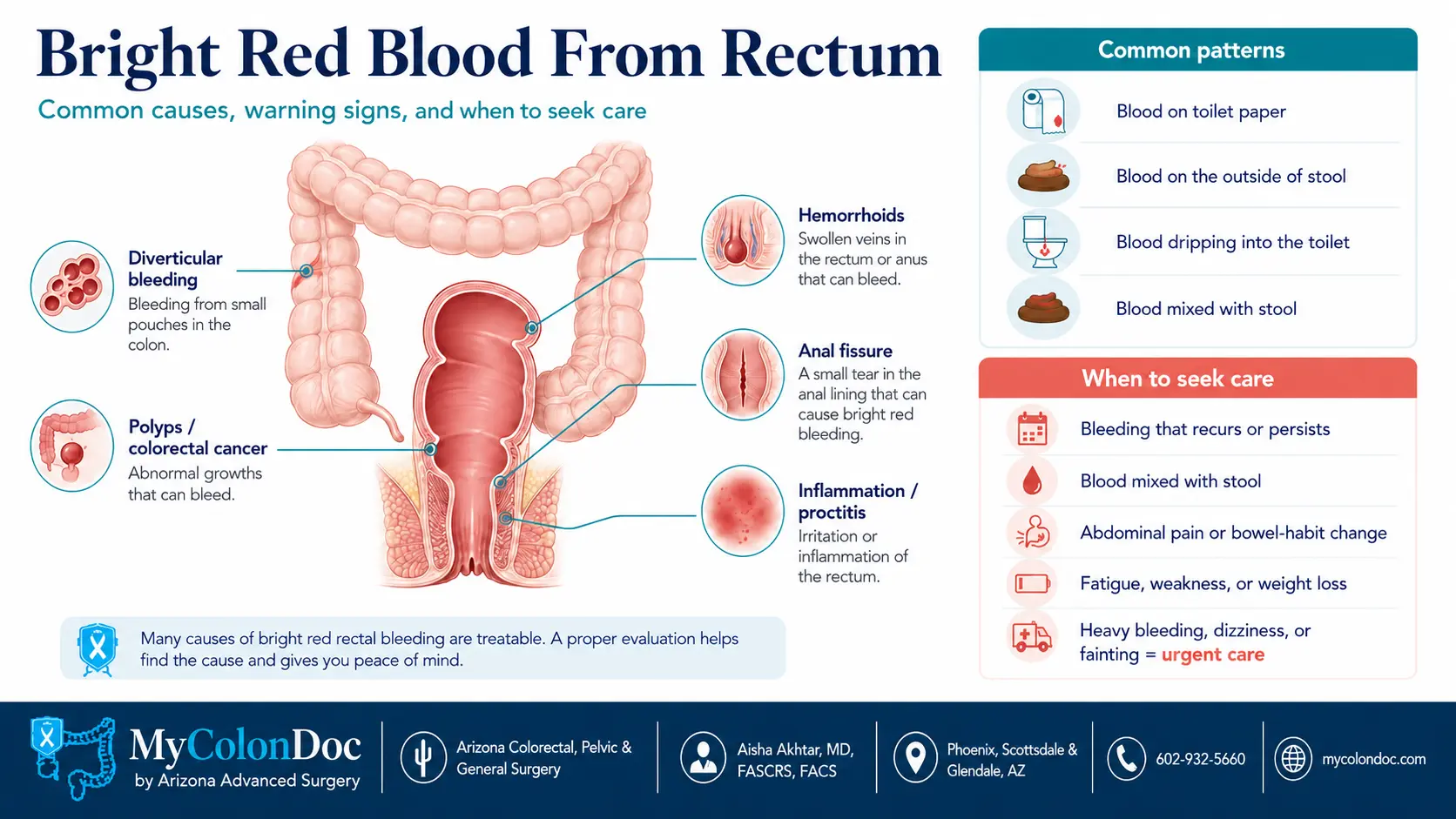
Bright red rectal bleeding may come from hemorrhoids or anal fissures but persistent recurrent or heavy bleeding should be medically evaluated to identify the source.
Bright red blood from the rectum most often means bleeding from the anus, rectum, or lower colon. Common causes include hemorrhoids and anal fissures, but diverticular disease, inflammation of the colon or rectum, polyps, and colorectal cancer can also cause visible red bleeding.
You may notice blood:
On toilet paper after wiping
Streaking the outside of the stool
Dripping into the toilet bowl
In the toilet water
Mixed with the stool
During or shortly after a bowel movement
The appearance of the blood can provide clues, but color alone cannot identify the cause. The 2024 American Society of Colon and Rectal Surgeons guideline specifically advises that rectal bleeding should not automatically be attributed to hemorrhoids.
Seek urgent medical care for heavy or continuous bleeding, fainting, marked dizziness, confusion, shortness of breath, a rapid heartbeat, severe abdominal pain, or signs of shock. Black, tarry stool or large-volume red or maroon bleeding also requires prompt evaluation.
What Does Bright Red Blood From the Rectum Mean?
Fresh red blood passed through the anus is commonly called hematochezia. It usually reflects bleeding from the lower gastrointestinal tract, which includes the colon, rectum, and anus.
The pattern may help narrow the possibilities:
What you notice
Possible explanation
Bright red blood only on toilet paper
Hemorrhoid, anal fissure, or another anal source
Bright red streaks on the outside of stool
Hemorrhoid or fissure may be possible
Blood dripping into the toilet
Internal hemorrhoids can do this, but other causes remain possible
Bright red blood mixed with stool
May indicate bleeding farther inside the rectum or colon
Larger-volume painless red or maroon bleeding
Diverticular or another colonic source may be possible
Bright red blood with diarrhea or mucus
Colitis, proctitis, infection, or inflammatory bowel disease may be possible
Recurrent bleeding with bowel-habit change or weight loss
Requires evaluation for colorectal disease
These are patterns, not diagnoses. More than one condition can be present at the same time.
Bright Red Blood After a Bowel Movement
Bright red blood noticed during or immediately after a bowel movement is commonly associated with hemorrhoids or an anal fissure, particularly when constipation, hard stool, or straining is present.
Hemorrhoids are more likely when:
Bleeding is bright red
Blood appears on toilet paper, streaks the stool, or drips into the bowl
Bleeding is painless
There is anal itching, prolapse, mucus, or difficulty cleaning
Internal hemorrhoids commonly cause painless bright red rectal bleeding.
A small amount of bright red blood on toilet paper often comes from tissue close to the anal opening.
Common possibilities include:
Internal hemorrhoids
External hemorrhoid irritation
Anal fissure
Skin irritation
Inflammation of the anal canal or rectum
Although this pattern is commonly caused by a benign anorectal condition, repeated bleeding should still be evaluated—especially when the diagnosis has never been confirmed.
If you are trying to distinguish hemorrhoid bleeding from blood coming from farther inside the bowel, see Blood in Stool vs Hemorrhoids.
Bright Red Blood in the Toilet Bowl
Internal hemorrhoids can cause enough bright red bleeding to drip into the toilet or discolor the water. ASCRS notes that hemorrhoidal bleeding may be bright red and can sometimes appear brisk.
However, the amount of blood cannot reliably identify the source.
A larger amount of painless red or maroon bleeding can also occur with diverticular bleeding or another colonic source. Significant or ongoing bleeding should be assessed promptly.
Painless Bright Red Rectal Bleeding
Painless bleeding is often associated with internal hemorrhoids, but painless does not mean harmless.
Other causes of painless rectal bleeding can include:
Diverticular bleeding
Colorectal polyps
Angiodysplasia
Colorectal cancer
Other conditions affecting the colon or rectum
The American Cancer Society lists bright red rectal bleeding among possible symptoms of colorectal cancer, along with changes in bowel habits, abdominal pain, weakness or fatigue, and unintended weight loss.
Arrange an evaluation when painless bleeding:
Recurs
Persists
Increases in amount
Is mixed with stool
Occurs without an obvious anal explanation
Is associated with bowel-habit changes
Occurs with fatigue, anemia, abdominal symptoms, or unexplained weight loss
Blood only on the tissue or coating the outside of stool may be more consistent with an anal source. Blood that appears mixed throughout the stool may suggest that bleeding occurred farther inside the rectum or colon.
Possible causes include:
Colitis
Inflammatory bowel disease
Diverticular disease
Polyps
Colorectal cancer
Other lower gastrointestinal bleeding sources
This distinction is useful but not definitive. Stool movement and the amount of bleeding can change how blood appears.
Persistent blood mixed with stool deserves medical evaluation.
Common Causes of Bright Red Rectal Bleeding
1. Hemorrhoids
Hemorrhoids are enlarged or symptomatic hemorrhoidal tissue in or around the anal canal. Internal hemorrhoids may cause:
Painless bright red bleeding
Blood on toilet paper
Blood streaking the stool
Blood dripping into the toilet
Prolapse
Mucus or irritation
Rectal bleeding should not be assumed to come from hemorrhoids simply because hemorrhoids are present.
2. Anal Fissure
An anal fissure is a tear in the lining of the anal canal. Typical symptoms include:
Sharp pain during defecation
Burning or aching afterward
Bright red blood on the tissue or stool
Symptoms after hard stool, constipation, or sometimes diarrhea
3. Diverticular Bleeding
Diverticula are small pouches in the colon wall. When a blood vessel associated with a diverticulum bleeds, the result may be sudden, painless red or maroon bleeding.
4. Colitis or Proctitis
Inflammation of the colon or rectum can cause bleeding, often with:
Diarrhea
Mucus
Urgency
Abdominal cramping
Rectal discomfort
Potential causes include inflammatory bowel disease, infection, ischemic colitis, and other inflammatory conditions.
5. Colon or Rectal Polyps
Most polyps do not cause symptoms, but some may bleed. Certain types of colorectal polyps can become cancerous over time.
6. Colorectal Cancer
Colorectal cancer can cause:
Bright red rectal bleeding
Darker blood in the stool
Persistent bowel-habit changes
Abdominal pain or cramping
Weakness or fatigue
Iron-deficiency anemia
Unintended weight loss
Most people with bright red rectal bleeding do not have colorectal cancer. However, the blood’s color does not exclude cancer.
Bright Red Blood vs Dark Red or Black Stool
The color of gastrointestinal bleeding sometimes provides clues about where the bleeding originated.
Appearance
What it may suggest
Bright red blood
Often lower gastrointestinal or anorectal bleeding
Dark red or maroon blood
May come from the colon or another gastrointestinal source
Black, sticky, tar-like stool
Often associated with bleeding higher in the gastrointestinal tract
A rapid or substantial gastrointestinal bleed can sometimes produce patterns that do not follow these general rules. Symptoms and blood color should therefore be interpreted together rather than in isolation.
Is Bright Red Blood From Hemorrhoids or Something Else?
No home observation can determine the source with certainty.
Hemorrhoids become more likely when there is:
Painless bright red bleeding with bowel movements
Blood on toilet paper or streaking the stool surface
Anal prolapse, itching, or mucus
A known history of symptomatic internal hemorrhoids
Another source deserves consideration when there is:
Blood mixed throughout the stool
Persistent or progressively worsening bleeding
New constipation or diarrhea
Abdominal pain or distention
Unexplained weight loss
Iron-deficiency anemia
A personal or family history of colorectal cancer or advanced polyps
Continued bleeding despite successful hemorrhoid treatment
ASCRS recommends considering complete colon evaluation in selected patients with rectal bleeding, particularly when no obvious anorectal source is found, associated abdominal symptoms are present, bleeding continues after hemorrhoid treatment, or colorectal cancer screening is due.
When Should You See a Doctor for Bright Red Rectal Bleeding?
Schedule a medical evaluation when the bleeding is:
Recurrent
Persistent
Increasing in amount
Unexplained
Mixed with stool
Associated with abdominal pain or distention
Associated with a new or progressive change in bowel habits
Accompanied by fatigue, weakness, or possible anemia
Associated with unexplained weight loss
Continuing despite hemorrhoid treatment
Occurring in someone with colorectal cancer risk factors
You should also discuss bleeding with a clinician if you take anticoagulants, antiplatelet medications, aspirin, or other medicines that may affect bleeding.
Do not stop a prescribed blood thinner without instructions from the clinician who manages it.
When Is Bright Red Rectal Bleeding an Emergency?
Seek emergency care for:
Heavy or continuous rectal bleeding
Passing a large amount of red or maroon blood
Fainting or near-fainting
Severe dizziness or marked weakness
Shortness of breath
A rapid heartbeat
Confusion
Pale, cold, or clammy skin
Severe or rapidly worsening abdominal pain
Black, tarry stool accompanied by weakness or dizziness
Acute gastrointestinal bleeding can cause significant blood loss and, in severe cases, shock.
How Is Bright Red Rectal Bleeding Evaluated?
Evaluation is individualized according to the bleeding pattern, associated symptoms, medications, medical history, family history, age, and prior colorectal screening.
A colorectal specialist may perform:
Medical history
Important details include:
When the bleeding started
Frequency and amount
Whether blood is on the tissue, coating the stool, or mixed with stool
Constipation, diarrhea, or straining
Anal pain or prolapse
Abdominal symptoms
Changes in bowel habits
Medication use
Personal or family history of colorectal disease
Prior colonoscopy or other screening
Anorectal examination
Evaluation may include:
Inspection of the anus
Digital rectal examination
Anoscopy
These steps can identify hemorrhoids, fissures, masses, inflammation, or other anorectal abnormalities.
Blood tests
Blood testing may be appropriate when the amount or duration of bleeding raises concern for anemia or significant blood loss.
Colonoscopy or other endoscopic evaluation
Colonoscopy may be recommended when:
No clear anorectal source is identified
Bleeding persists or recurs
Blood is mixed with stool
Abdominal symptoms or bowel-habit changes are present
Anemia is suspected
Colorectal cancer risk is increased
Screening is due
Bleeding continues after treatment of an apparent hemorrhoidal source
Does Age 45 Mean You Can Wait Until Then to Investigate Bleeding?
No.
The U.S. Preventive Services Task Force recommends routine colorectal cancer screening beginning at age 45 for average-risk adults without signs or symptoms.
Bright red rectal bleeding is a symptom. A person younger than 45 may still require diagnostic evaluation depending on the bleeding pattern, examination, family history, associated symptoms, and other risk factors.
The age-45 screening recommendation should not be used as a reason to delay evaluation of unexplained rectal bleeding.
What Can You Do While Waiting for an Evaluation?
If bleeding is minor and constipation or straining may be contributing:
Avoid straining during bowel movements
Avoid prolonged toilet sitting
Keep stool soft with appropriate dietary fiber and fluids
Record the frequency and approximate amount of bleeding
Note whether blood is on the paper, coating the stool, mixed with stool, or in the toilet
Track associated pain, constipation, diarrhea, abdominal symptoms, or bowel-habit changes
Bring a complete medication list to the appointment
These measures may reduce irritation from hemorrhoids or fissures but do not establish the source of bleeding.
Colorectal Evaluation for Bright Red Rectal Bleeding in Phoenix
Bright red rectal bleeding is often caused by a treatable anorectal condition, but identifying the correct source is important—particularly when bleeding is recurrent, unexplained, or associated with other symptoms.
Dr. Aisha Akhtar, MD is a board-certified colon and rectal surgeon who evaluates hemorrhoids, anal fissures, rectal bleeding, colon and rectal conditions, and other anorectal problems for patients in Phoenix, Scottsdale, Glendale, and surrounding Arizona communities.
Is bright red blood from the rectum usually hemorrhoids?
Hemorrhoids are a common cause of bright red rectal bleeding, particularly when blood appears on toilet paper, streaks the stool, or drips into the toilet after a bowel movement. However, rectal bleeding should not automatically be assumed to be hemorrhoids because other colorectal conditions can produce the same symptom.
Why is there bright red blood when I wipe?
Blood on toilet paper commonly comes from an anal source such as a hemorrhoid or anal fissure. Recurrent or unexplained bleeding should still be evaluated.
What causes bright red blood after a bowel movement?
Common causes include internal hemorrhoids and anal fissures. Other causes include inflammation, diverticular disease, polyps, and colorectal cancer. Associated symptoms and examination findings help determine the source.
Is painless bright red rectal bleeding concerning?
Painless bleeding can occur with internal hemorrhoids, but it can also occur with diverticular disease, polyps, and colorectal cancer. Recurrent, persistent, or unexplained painless bleeding warrants evaluation.
Can colorectal cancer cause bright red blood?
Yes. Colorectal cancer may cause bright red rectal bleeding as well as darker blood in the stool. Blood color alone cannot exclude colorectal cancer.
Does bright red blood mixed with stool need evaluation?
Yes, particularly if it is recurrent, persistent, associated with bowel-habit changes or abdominal symptoms, or there is no clear anorectal source.
Do I automatically need a colonoscopy for bright red rectal bleeding?
No. The appropriate evaluation depends on symptoms, examination findings, age, screening history, family history, and risk factors. ASCRS recommends complete colon evaluation in selected patients rather than automatically for every episode of hemorrhoidal-type bleeding.
When should bright red rectal bleeding be treated as an emergency?
Seek urgent care for heavy or continuous bleeding, fainting, severe dizziness, shortness of breath, rapid heartbeat, confusion, severe abdominal pain, or other signs of significant blood loss.
Medical Review & Editorial Standards
This educational page was developed for patients seeking clear information about bright red rectal bleeding and is medically aligned with current colorectal and gastrointestinal practice guidance.
Clinical authorship
Dr. Aisha Akhtar, MD is a board-certified colon and rectal surgeon with expertise in hemorrhoids, anal fissures, rectal bleeding, colon and rectal conditions, and other anorectal disorders.
How this page was developed
The medical content on this page is informed by established guidance and patient-education standards from leading organizations in colorectal surgery, gastroenterology, cancer prevention, and preventive medicine, including:
American Society of Colon and Rectal Surgeons (ASCRS)
National Institute of Diabetes and Digestive and Kidney Diseases (NIDDK)
American Cancer Society
U.S. Preventive Services Task Force (USPSTF)
These sources support the key clinical principles summarized on this page, including:
Bright red rectal bleeding should not automatically be assumed to come from hemorrhoids.
Hemorrhoids and anal fissures are common causes of bright red bleeding, but other colorectal conditions can produce the same symptom.
Heavy or ongoing gastrointestinal bleeding with dizziness, fainting, weakness, shortness of breath, or other signs of significant blood loss requires urgent evaluation.
Colorectal cancer can present with rectal bleeding, and blood color alone cannot establish or exclude a diagnosis.
The routine colorectal cancer screening age for average-risk adults does not replace diagnostic evaluation when a patient already has rectal bleeding or another concerning symptom.
Medical accuracy
This page is reviewed for clinical accuracy, clarity, and consistency with current colorectal care principles. Recommendations are intentionally written to help patients recognize patterns that may warrant routine, prompt, or emergency evaluation without attempting to diagnose the cause of bleeding from symptoms alone.
Last medically reviewed: August 13, 2026
This page provides general educational information and does not replace an individualized medical examination, diagnosis, or treatment recommendation.
Learn the most common causes of rectal bleeding including hemorrhoids, anal fissures, colon polyps, diverticular disease, inflammatory bowel disease, and colorectal cancer.
Painless rectal bleeding is often caused by internal hemorrhoids but may also indicate colon polyps or colorectal cancer. Learn the causes and when to seek care.
Rectal bleeding is often caused by hemorrhoids but can sometimes indicate colorectal cancer. Learn when bleeding is concerning and when to seek medical evaluation.
Rectal bleeding is often caused by hemorrhoids but can sometimes indicate serious conditions. Learn when rectal bleeding is harmless and when to seek medical care.
Rectal bleeding after a bowel movement is commonly caused by hemorrhoids or anal fissures but may indicate other conditions. Learn the causes and when to seek medical care.
Expert Colorectal Care
Specialist Evaluation for Rectal Bleeding in Phoenix
Dr. Aisha Akhtar, MD evaluates rectal bleeding and related anorectal symptoms with a focus on accurate diagnosis, evidence-based treatment, and timely exclusion of serious underlying disease.
“The whole office was wonderful. Dr Akhtar was excellent. She was thorough. She explained things extremely well. She answered all my questions. I...The whole office was wonderful. Dr Akhtar was excellent. She was thorough. She explained things extremely well. She answered all my questions. I never felt like she was rushing my exam.”
Jaime Peters
★★★★★
“Dr. Akhtar and the entire team made what could have been a very stressful experience feel comfortable, reassuring, and genuinely cared for from sta...Dr. Akhtar and the entire team made what could have been a very stressful experience feel comfortable, reassuring, and genuinely cared for from start to finish. Dr. Akhtar was professional, compassionate, and took the time to thoroughly explain everything before my procedure, which immediately put me at ease. The procedure itself went smoothly, and I truly felt I was in excellent hands the entire time. The office staff was also kind, organized, and attentive throughout the process. I’m incredibly grateful for the level of care, patience, and professionalism I received. I would absolutely recommend Dr. Akhtar to anyone looking for a skilled doctor who truly cares about their patients and their comfort.”
Michelle Abby
★★★★★
“I cannot express the how thankful I am for Dr. Akhtar. I had been to 4 other colorectal doctors, 3 gastro doctors before seeing Dr. Akhtar. I was c...I cannot express the how thankful I am for Dr. Akhtar. I had been to 4 other colorectal doctors, 3 gastro doctors before seeing Dr. Akhtar. I was crying in her office when she met me the first time. That didn't deter her. Not only that but she located the issue on my first visit. She is kind, caring, thorough and incredibly knowledgeable. She listens, spends time with you and doesn't talk over you. I've needed extra time to discuss my case many times and she has always taken the time that I needed. I've brought to her research I've read, and she always already knows about the publications. The staff are kind and helpful. I dont know what I would have done without finding her. Another health care provider recommended her highly as do I.”
Lorena Zeilman
★★★★★
“Best colorectal surgeon I’ve ever met. Dr. Akhtar is compassionate, gentle, warm, and caring. I came to her in Glendale after having a horrific exp...Best colorectal surgeon I’ve ever met. Dr. Akhtar is compassionate, gentle, warm, and caring. I came to her in Glendale after having a horrific experience with a general surgeon in Flagstaff (where I live). The Flagstaff surgeon caused a hemorrhage that almost cost me my life, and then I developed stenosis after the emergency room surgeon “fixed” the hemorrhage. Dr. Akhtar was kind enough to take me as a patient (most surgeons will not take a patient who has already been operated by another surgeon due to liability). She was very respectful and gentle in the examination, and was even able to fit me in for an outpatient procedure under sedation the very same day (knowing that I drove over 2 hours to see her). I could not be happier with her. She took the time to personally call me the next day to check on my progress. You do not see this type of doctor very often anymore. She is someone who is in it for the patient, and you can tell. I will continue to drive over 4 hours there and back to receive her high quality care and expertise. Cannot recommend her highly enough.”
Brianna Stabler
★★★★★
“Dr. Akhtar is THE BEST provider I have ever seen, period. She is incredibly knowledgeable, informative, and above all so kind. I have not met...Dr. Akhtar is THE BEST provider I have ever seen, period. She is incredibly knowledgeable, informative, and above all so kind. I have not met many people who have as comforting a bedside manner as she does. I was educated properly every step of the way and felt confident doing so because of her caring demeanor. Her PA Moses is also so friendly and upbeat, helping to ease any tension you may be feeling prior to the exam. The energy both Dr. Akhtar and Moses bring was paramount to how excellent my experience was here. Given their specialty, it would be easy to have an uncomfortable experience. However, they go the extra mile to make sure you are comfortable and reassured before anything is done. I cannot recommend this practice enough. Thank you Dr. Akhtar for the genuine concern and care you provided to me! Both my body and my outlook on my health outcomes are better off because of you.”
James Miller
★★★★★Sep 21, 2026
“Amazing staff and Doctor. So caring and make you feel welcome”
Rachel Johnson
★★★★★Sep 9, 2026
“Dr Akhtar has a wonderful bedside manner, explains everything thoroughly and is an exceptionally skilled surgeon. We love her. :)”
Linda Heyman
★★★★★Sep 5, 2026
“Friendly office and excellent doctor”
Carol Grove
★★★★★Sep 3, 2026
“Dr. Aktar was highly recommended by my primary care physician as being a good fit for me. We covered much during this initial visit and all set for...Dr. Aktar was highly recommended by my primary care physician as being a good fit for me. We covered much during this initial visit and all set for a colonoscopy next month.”