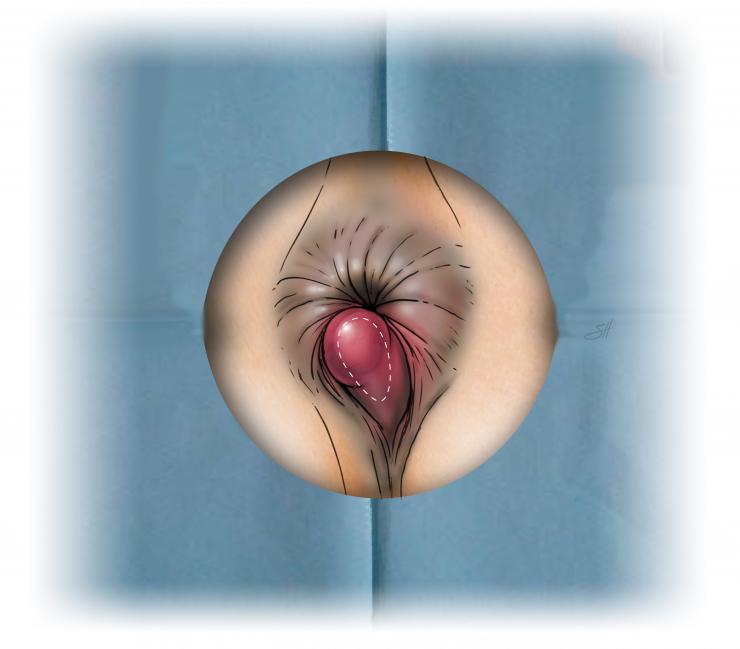
A sudden purple lump near the anus is often caused by a thrombosed hemorrhoid, sometimes described as a purple hemorrhoid, blue hemorrhoid, or “purple anus.” This happens when a blood clot forms inside an external hemorrhoid, causing swelling, firmness, discoloration, and pain.
Patients often notice the lump suddenly after straining, constipation, heavy lifting, prolonged sitting, or pregnancy. The area may feel like a painful pea, marble, or grape under the skin near the anal opening.
Although a thrombosed hemorrhoid can be very painful and alarming, it is usually not dangerous. However, not every purple or painful lump near the anus is a hemorrhoid. Dr. Aisha Akhtar, a board-certified colorectal surgeon in Phoenix, evaluates painful anal lumps, purple hemorrhoids, rectal bleeding, and other anorectal conditions that can look similar.
A thrombosed hemorrhoid occurs when a blood clot forms inside an external hemorrhoid.
Why Is There a Purple Lump Near My Anus?
A purple lump near the anus is commonly caused by a thrombosed external hemorrhoid. The purple or bluish color usually develops when blood becomes trapped under the skin and forms a clot.
Patients may search for this as:
Purple anus
Purple hemorrhoid
Blue hemorrhoid
Painful purple bump near anus
Hard lump near anus
Blood clot in hemorrhoid
In many cases, these descriptions refer to the same condition: a thrombosed external hemorrhoid. Still, other anorectal problems can sometimes look similar, including an abscess, fissure-related swelling, anal skin tag, wart, prolapse, or another lesion. An exam is the safest way to confirm the diagnosis.
What Is a Thrombosed Hemorrhoid?
A thrombosed hemorrhoid occurs when a blood clot, also called a thrombus, forms inside an external hemorrhoid.
This can cause the hemorrhoid to become:
Enlarged
Firm or hard
Tender
Swollen
Purple, blue, or dark red
External hemorrhoids form under the skin around the anus. When one becomes thrombosed, the clot stretches the surrounding skin, which is why the pain can be sudden and intense.
Is a Purple Hemorrhoid Usually a Thrombosed Hemorrhoid?
Often, yes. A purple hemorrhoid is commonly a thrombosed external hemorrhoid, especially when it appears suddenly and causes significant pain.
The color change happens because blood becomes trapped inside the hemorrhoid and forms a clot. This creates pressure, swelling, tenderness, and discoloration under the skin.
A purple hemorrhoid may:
Appear suddenly
Feel firm or tender
Cause pain when sitting
Hurt during bowel movements
Become swollen over 1 to 2 days
Bleed if the surface becomes irritated or opens
A purple hemorrhoid is often painful but usually not dangerous. However, if the lump is rapidly enlarging, draining pus, associated with fever, or causing heavy bleeding, it should be evaluated promptly.
What Does a Thrombosed Hemorrhoid Look Like?
A thrombosed hemorrhoid often looks like a purple, blue, or dark red lump near the anus. It may sit right at the anal opening or just outside it.
Typical features include:
A firm lump near the anus
Purple or bluish discoloration
Swelling around the anal opening
Tenderness to touch
Pain with sitting or wiping
The lump may feel similar to a small marble or grape under the skin.
Some patients notice it after:
Straining during a bowel movement
Constipation
Heavy lifting
Prolonged sitting
Pregnancy
Because several anorectal conditions can look similar, a persistent or painful lump should not be self-diagnosed based only on appearance.
Symptoms of a Thrombosed Hemorrhoid
Symptoms usually develop suddenly and may include:
Severe anal pain
A hard lump near the anus
A purple or bluish bump
Swelling around the anal opening
Tenderness when sitting
Pain during bowel movements
Bleeding if the clot ruptures or the skin becomes irritated
Pain is usually most intense during the first 48–72 hours. After that, the clot often begins to shrink and symptoms gradually improve.
What Causes a Thrombosed Hemorrhoid?
Thrombosed hemorrhoids occur when pressure increases in the veins around the anus, allowing blood to pool and clot.
Common triggers include:
Straining during bowel movements
Chronic constipation
Chronic diarrhea
Prolonged sitting on the toilet
Heavy lifting
Pregnancy
Obesity
Long periods of sitting
Low-fiber diet or dehydration
These factors increase pressure in the rectal and anal veins, which can contribute to hemorrhoids and thrombosis.
Most thrombosed hemorrhoids improve gradually over time.
Time
What Often Happens
1–3 days
Pain is usually most severe
4–7 days
Pain may begin to improve; swelling can remain
1–2 weeks
The clot slowly shrinks
2–3 weeks
The lump often becomes much smaller
After healing
A small skin tag may remain
Some patients improve faster, while others have swelling or a residual skin tag for longer. If pain is worsening instead of improving, or if bleeding persists, medical evaluation is recommended.
Treatment for a Thrombosed Hemorrhoid
Treatment depends on how severe the pain is, how long the lump has been present, and whether the diagnosis is clear.
Conservative Treatment
Many thrombosed hemorrhoids improve without surgery. Conservative treatment may include:
Warm sitz baths
Anti-inflammatory medication when safe for the patient
Topical hemorrhoid medication
Fiber supplementation
Stool softeners
Drinking adequate fluids
Avoiding straining
Limiting time on the toilet
These measures help reduce irritation and allow the clot to resolve naturally.
Office-Based Clot Removal or Excision
If a thrombosed hemorrhoid is causing severe pain and the patient presents early, a colorectal surgeon may discuss an office-based procedure.
This may involve:
Local anesthesia
A small incision or excision
Removal of the clot or thrombosed hemorrhoid tissue
Wound care instructions afterward
This option is generally considered when symptoms are severe, the diagnosis is clear, and the timing suggests that a procedure may provide faster relief.
Surgery for Recurrent or Severe Hemorrhoids
Most thrombosed hemorrhoids do not require major surgery. Surgery may be considered if thrombosed hemorrhoids recur frequently or if there is significant underlying hemorrhoidal disease.
Rubber band ligation is generally used for internal hemorrhoids, not for an acute thrombosed external hemorrhoid. Dr. Akhtar can determine the appropriate treatment after an exam.
Is a Purple Hemorrhoid Dangerous?
Usually, no. A purple hemorrhoid is often painful but not dangerous. In many cases, it represents a thrombosed external hemorrhoid that gradually improves.
However, you should seek medical evaluation if you have:
Severe or worsening pain
Heavy or persistent bleeding
A rapidly enlarging lump
Fever
Drainage or pus
Symptoms that do not improve
Recurrent painful hemorrhoids
A new lump and no prior diagnosis
Other anorectal conditions can sometimes mimic a thrombosed hemorrhoid, including:
Anal fissure
Perianal abscess
Anal skin tag
Rectal prolapse
Anal wart
Other anorectal lesions
A specialist can confirm the diagnosis and recommend the most appropriate treatment.
When Should You See a Colorectal Surgeon?
You should consider seeing a colorectal surgeon if you have a painful purple lump near the anus, severe hemorrhoid pain, rectal bleeding, or recurrent thrombosed hemorrhoids.
A specialist evaluation can help determine:
Whether the lump is truly a thrombosed hemorrhoid
Whether another condition is causing the pain or bleeding
Whether conservative care or an office procedure is the best option
For patients in Phoenix and the surrounding area, Dr. Aisha Akhtar evaluates thrombosed hemorrhoids, purple hemorrhoids, painful anal lumps, and rectal bleeding.
Preventing Thrombosed Hemorrhoids
Prevention focuses on reducing pressure in the rectal and anal veins.
Helpful strategies include:
Eating a high-fiber diet
Drinking enough fluids
Avoiding prolonged sitting on the toilet
Avoiding straining
Exercising regularly
Maintaining a healthy weight
Treating constipation early
These steps may reduce the risk of hemorrhoid flare-ups and recurrent thrombosis.
FAQ About Purple Hemorrhoids
Why is my hemorrhoid purple?
A hemorrhoid may look purple when blood becomes trapped inside an external hemorrhoid and forms a clot. This is commonly called a thrombosed hemorrhoid.
Is a purple hemorrhoid always thrombosed?
Not always. A purple lump near the anus is often a thrombosed external hemorrhoid, but other anorectal conditions can look similar. A colorectal specialist can confirm the diagnosis.
What does a thrombosed hemorrhoid feel like?
It often feels like a firm, tender lump near the anus. Patients may describe it as a painful pea, marble, or grape under the skin.
How long does a purple hemorrhoid last?
Pain is often worst during the first 48–72 hours. The lump may shrink over 1–3 weeks as the clot resolves.
Can a thrombosed hemorrhoid go away without surgery?
Yes. Many thrombosed hemorrhoids improve with conservative treatment, including sitz baths, fiber, stool softeners, fluids, and avoiding straining.
When is a purple lump near the anus urgent?
Seek prompt evaluation if the pain is severe or worsening, the lump is rapidly enlarging, there is fever, pus, heavy bleeding, or symptoms are not improving.
Why does my anus look purple?
A purple color around the anus is often caused by trapped blood under the skin, such as a thrombosed external hemorrhoid. Other conditions can also cause discoloration, swelling, or bruising, so persistent pain, bleeding, drainage, or a rapidly enlarging lump should be evaluated.
Why is my butthole purple?
Patients may describe a thrombosed hemorrhoid as a purple or blue bump at the anal opening. The color usually comes from a blood clot inside an external hemorrhoid. Because other anorectal conditions can look similar, an exam is recommended if symptoms are painful, new, or not improving.
Are hemorrhoids purple?
Hemorrhoids can look purple or blue when blood becomes trapped inside an external hemorrhoid and forms a clot. This is called a thrombosed hemorrhoid.
“The whole office was wonderful. Dr Akhtar was excellent. She was thorough. She explained things extremely well. She answered all my questions. I...The whole office was wonderful. Dr Akhtar was excellent. She was thorough. She explained things extremely well. She answered all my questions. I never felt like she was rushing my exam.”
Jaime Peters
★★★★★
“Dr. Akhtar and the entire team made what could have been a very stressful experience feel comfortable, reassuring, and genuinely cared for from sta...Dr. Akhtar and the entire team made what could have been a very stressful experience feel comfortable, reassuring, and genuinely cared for from start to finish. Dr. Akhtar was professional, compassionate, and took the time to thoroughly explain everything before my procedure, which immediately put me at ease. The procedure itself went smoothly, and I truly felt I was in excellent hands the entire time. The office staff was also kind, organized, and attentive throughout the process. I’m incredibly grateful for the level of care, patience, and professionalism I received. I would absolutely recommend Dr. Akhtar to anyone looking for a skilled doctor who truly cares about their patients and their comfort.”
Michelle Abby
★★★★★
“I cannot express the how thankful I am for Dr. Akhtar. I had been to 4 other colorectal doctors, 3 gastro doctors before seeing Dr. Akhtar. I was c...I cannot express the how thankful I am for Dr. Akhtar. I had been to 4 other colorectal doctors, 3 gastro doctors before seeing Dr. Akhtar. I was crying in her office when she met me the first time. That didn't deter her. Not only that but she located the issue on my first visit. She is kind, caring, thorough and incredibly knowledgeable. She listens, spends time with you and doesn't talk over you. I've needed extra time to discuss my case many times and she has always taken the time that I needed. I've brought to her research I've read, and she always already knows about the publications. The staff are kind and helpful. I dont know what I would have done without finding her. Another health care provider recommended her highly as do I.”
Lorena Zeilman
★★★★★
“Best colorectal surgeon I’ve ever met. Dr. Akhtar is compassionate, gentle, warm, and caring. I came to her in Glendale after having a horrific exp...Best colorectal surgeon I’ve ever met. Dr. Akhtar is compassionate, gentle, warm, and caring. I came to her in Glendale after having a horrific experience with a general surgeon in Flagstaff (where I live). The Flagstaff surgeon caused a hemorrhage that almost cost me my life, and then I developed stenosis after the emergency room surgeon “fixed” the hemorrhage. Dr. Akhtar was kind enough to take me as a patient (most surgeons will not take a patient who has already been operated by another surgeon due to liability). She was very respectful and gentle in the examination, and was even able to fit me in for an outpatient procedure under sedation the very same day (knowing that I drove over 2 hours to see her). I could not be happier with her. She took the time to personally call me the next day to check on my progress. You do not see this type of doctor very often anymore. She is someone who is in it for the patient, and you can tell. I will continue to drive over 4 hours there and back to receive her high quality care and expertise. Cannot recommend her highly enough.”
Brianna Stabler
★★★★★
“Dr. Akhtar is THE BEST provider I have ever seen, period. She is incredibly knowledgeable, informative, and above all so kind. I have not met...Dr. Akhtar is THE BEST provider I have ever seen, period. She is incredibly knowledgeable, informative, and above all so kind. I have not met many people who have as comforting a bedside manner as she does. I was educated properly every step of the way and felt confident doing so because of her caring demeanor. Her PA Moses is also so friendly and upbeat, helping to ease any tension you may be feeling prior to the exam. The energy both Dr. Akhtar and Moses bring was paramount to how excellent my experience was here. Given their specialty, it would be easy to have an uncomfortable experience. However, they go the extra mile to make sure you are comfortable and reassured before anything is done. I cannot recommend this practice enough. Thank you Dr. Akhtar for the genuine concern and care you provided to me! Both my body and my outlook on my health outcomes are better off because of you.”
Linda Heyman
★★★★★Sep 5, 2026
“Friendly office and excellent doctor”
Carol Grove
★★★★★Sep 3, 2026
“Dr. Aktar was highly recommended by my primary care physician as being a good fit for me. We covered much during this initial visit and all set for...Dr. Aktar was highly recommended by my primary care physician as being a good fit for me. We covered much during this initial visit and all set for a colonoscopy next month.”
Henry Tom
★★★★★Sep 1, 2026
“Very professional & kind !”
Arianna Olive
★★★★★Aug 27, 2026
“Aisha Akhtar is truly the best and very gifted at what she does. Not only was she very friendly and put me at ease, but all the knowledge she has m...Aisha Akhtar is truly the best and very gifted at what she does. Not only was she very friendly and put me at ease, but all the knowledge she has makes you feel like you’re in the right hands. Speedy recovery and no issues at all, highly recommend her!”
Edward Pinkhasov
★★★★★Aug 24, 2026
“I’m so grateful I found this doctor. She’s exceptionally thorough and brilliantly well spoken. She was answering questions before I had a chance to...I’m so grateful I found this doctor. She’s exceptionally thorough and brilliantly well spoken. She was answering questions before I had a chance to ask them. After multiple trials and errors I feel like I’ve finally landed in the right place and in caring hands. She’s also sensitive to your sensitivities and offers different treatments accordingly. What impressed me most is the fact that she studied my case before I even showed up. You’d expect that from all doctors. You’d be mistaken in doing so. A true medical professional.”