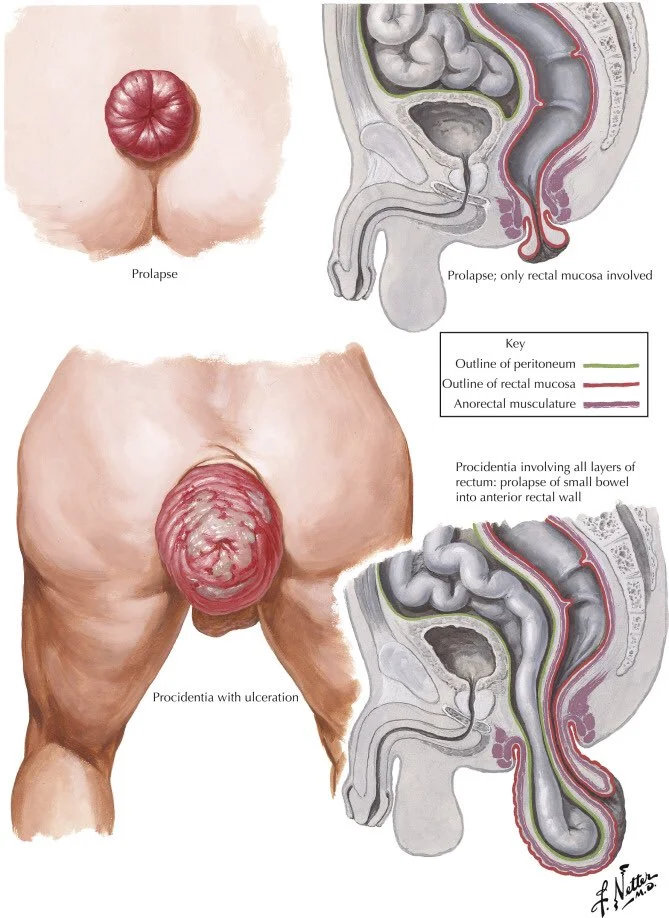
Rectal prolapse develops when the normal support structures of the rectum weaken, allowing rectal tissue to descend or protrude through the anus.
Rectal prolapse occurs when the rectum loses its normal attachments and descends downward. It may fold inward without becoming visible, involve only the rectal lining, or extend through the anus as a full-thickness prolapse.
Rectal prolapse is different from hemorrhoids. Both can cause bleeding or protruding tissue, but they arise from different anatomy and may require different treatment. An examination by a colorectal specialist can establish the diagnosis.
Types of Rectal Prolapse
The term rectal prolapse can describe several related conditions.
Full-Thickness External Rectal Prolapse
The entire wall of the rectum protrudes through the anus. It may initially appear only during a bowel movement and return inside on its own. As it progresses, a person may need to push it back inside, or it may remain outside.
Full-thickness prolapse often appears as a circular segment of red or pink tissue with concentric folds.
Internal Rectal Prolapse
Internal rectal prolapse, also called rectal intussusception, occurs when the rectum folds into itself but does not pass through the anus. It may contribute to obstructed defecation, straining, pressure, or incomplete emptying.
Because it is not visible externally, internal prolapse may require defecography or another functional evaluation when the history and examination do not establish the diagnosis.
Mucosal Prolapse
Mucosal prolapse involves the inner lining of the rectum rather than the full thickness of the rectal wall. It can resemble prolapsing hemorrhoids, making an accurate examination important before treatment is selected.
What Causes Rectal Prolapse?
Rectal prolapse usually develops through a combination of weakened pelvic support, altered bowel function, and repeated pressure or straining. No single cause explains every case.
Associated factors may include:
Longstanding constipation or repeated straining
Chronic diarrhea or frequent bowel movements
Pelvic floor weakness
Prior childbirth or pelvic-floor injury
Aging and loss of tissue support
Neurologic conditions that affect pelvic or bowel function
Previous pelvic surgery in selected patients
Other pelvic-organ prolapse
Constipation may contribute to prolapse, but prolapse can also worsen constipation by interfering with normal evacuation. Some patients experience both constipation and fecal incontinence.
Does Rectal Prolapse Get Worse Over Time?
Rectal prolapse often develops gradually. Tissue may first protrude only during a bowel movement and return inside afterward. Over time, it may appear with less effort, require manual reduction, or remain outside.
Progression varies from person to person. Treating constipation, diarrhea, and straining may reduce irritation and bowel-related symptoms, but these measures generally do not anatomically correct an established full-thickness prolapse.
Rectal prolapse does not itself become colorectal cancer. However, bleeding, a new mass, or a change in bowel habits should still be evaluated because other colorectal conditions can produce similar symptoms.
How Is Rectal Prolapse Diagnosed?
Diagnosis starts with a detailed history and anorectal examination. The clinician may ask when the tissue appears, whether it returns inside, and whether constipation, incomplete emptying, mucus drainage, bleeding, or stool leakage is present.
The examination may include:
Inspection of the anal and rectal area
Digital rectal examination
Assessment while bearing down or straining when appropriate
Evaluation of anal sphincter tone and pelvic-floor function
If the prolapse is intermittent, a photograph taken by the patient during an episode may sometimes help the clinician understand what occurred, but it does not replace an examination.
Selected patients may need:
Defecography to evaluate the rectum and pelvic floor during evacuation
Anorectal manometry to assess muscle pressures, sensation, and reflexes
Colonic transit testing when severe longstanding constipation is present
Colonoscopy when indicated by bleeding, screening history, bowel changes, or surgical planning
Arrange an evaluation when tissue repeatedly protrudes from the anus, requires manual reduction, or is associated with bleeding, mucus drainage, difficult evacuation, or stool leakage.
Seek urgent medical care if the prolapse cannot be returned inside, becomes dark or dusky, develops severe or rapidly worsening pain, or causes heavy bleeding.
Rectal Prolapse Evaluation in Phoenix
Dr. Aisha Akhtar, MD is a board-certified colon and rectal surgeon who evaluates rectal prolapse and related pelvic-floor conditions for patients in Phoenix, Scottsdale, Glendale, and surrounding Arizona communities.
Adult full-thickness rectal prolapse usually does not heal on its own. Learn why symptoms may come and go, what self-care can help, and when to seek treatment.
Rectal prolapse is not always an emergency. Learn which warning signs—trapped or dark tissue, severe pain, swelling, or heavy bleeding—require urgent care.
Nonsurgical care can improve constipation, straining, and irritation but usually cannot repair adult full-thickness rectal prolapse. Learn what may help.
Compare rectal prolapse and hemorrhoids by appearance, symptoms, tissue pattern, bowel problems, and treatment. Learn why an examination is often needed.
Learn how constipation, straining, pelvic-floor weakness, childbirth, aging, diarrhea, and other factors may contribute to rectal prolapse.
Expert Colorectal Care
Expert Rectal Prolapse Care in Phoenix
Dr. Aisha Akhtar, MD provides expert evaluation and treatment of rectal prolapse, including assessment of associated constipation, pelvic floor dysfunction, and fecal incontinence. She offers individualized care ranging from symptom-directed conservative management to advanced surgical repair when indicated.
“The whole office was wonderful. Dr Akhtar was excellent. She was thorough. She explained things extremely well. She answered all my questions. I...The whole office was wonderful. Dr Akhtar was excellent. She was thorough. She explained things extremely well. She answered all my questions. I never felt like she was rushing my exam.”
Jaime Peters
★★★★★
“Dr. Akhtar and the entire team made what could have been a very stressful experience feel comfortable, reassuring, and genuinely cared for from sta...Dr. Akhtar and the entire team made what could have been a very stressful experience feel comfortable, reassuring, and genuinely cared for from start to finish. Dr. Akhtar was professional, compassionate, and took the time to thoroughly explain everything before my procedure, which immediately put me at ease. The procedure itself went smoothly, and I truly felt I was in excellent hands the entire time. The office staff was also kind, organized, and attentive throughout the process. I’m incredibly grateful for the level of care, patience, and professionalism I received. I would absolutely recommend Dr. Akhtar to anyone looking for a skilled doctor who truly cares about their patients and their comfort.”
Michelle Abby
★★★★★
“I cannot express the how thankful I am for Dr. Akhtar. I had been to 4 other colorectal doctors, 3 gastro doctors before seeing Dr. Akhtar. I was c...I cannot express the how thankful I am for Dr. Akhtar. I had been to 4 other colorectal doctors, 3 gastro doctors before seeing Dr. Akhtar. I was crying in her office when she met me the first time. That didn't deter her. Not only that but she located the issue on my first visit. She is kind, caring, thorough and incredibly knowledgeable. She listens, spends time with you and doesn't talk over you. I've needed extra time to discuss my case many times and she has always taken the time that I needed. I've brought to her research I've read, and she always already knows about the publications. The staff are kind and helpful. I dont know what I would have done without finding her. Another health care provider recommended her highly as do I.”
Lorena Zeilman
★★★★★
“Best colorectal surgeon I’ve ever met. Dr. Akhtar is compassionate, gentle, warm, and caring. I came to her in Glendale after having a horrific exp...Best colorectal surgeon I’ve ever met. Dr. Akhtar is compassionate, gentle, warm, and caring. I came to her in Glendale after having a horrific experience with a general surgeon in Flagstaff (where I live). The Flagstaff surgeon caused a hemorrhage that almost cost me my life, and then I developed stenosis after the emergency room surgeon “fixed” the hemorrhage. Dr. Akhtar was kind enough to take me as a patient (most surgeons will not take a patient who has already been operated by another surgeon due to liability). She was very respectful and gentle in the examination, and was even able to fit me in for an outpatient procedure under sedation the very same day (knowing that I drove over 2 hours to see her). I could not be happier with her. She took the time to personally call me the next day to check on my progress. You do not see this type of doctor very often anymore. She is someone who is in it for the patient, and you can tell. I will continue to drive over 4 hours there and back to receive her high quality care and expertise. Cannot recommend her highly enough.”
Brianna Stabler
★★★★★
“Dr. Akhtar is THE BEST provider I have ever seen, period. She is incredibly knowledgeable, informative, and above all so kind. I have not met...Dr. Akhtar is THE BEST provider I have ever seen, period. She is incredibly knowledgeable, informative, and above all so kind. I have not met many people who have as comforting a bedside manner as she does. I was educated properly every step of the way and felt confident doing so because of her caring demeanor. Her PA Moses is also so friendly and upbeat, helping to ease any tension you may be feeling prior to the exam. The energy both Dr. Akhtar and Moses bring was paramount to how excellent my experience was here. Given their specialty, it would be easy to have an uncomfortable experience. However, they go the extra mile to make sure you are comfortable and reassured before anything is done. I cannot recommend this practice enough. Thank you Dr. Akhtar for the genuine concern and care you provided to me! Both my body and my outlook on my health outcomes are better off because of you.”
James Miller
★★★★★Sep 21, 2026
“Amazing staff and Doctor. So caring and make you feel welcome”
Rachel Johnson
★★★★★Sep 9, 2026
“Dr Akhtar has a wonderful bedside manner, explains everything thoroughly and is an exceptionally skilled surgeon. We love her. :)”
Linda Heyman
★★★★★Sep 5, 2026
“Friendly office and excellent doctor”
Carol Grove
★★★★★Sep 3, 2026
“Dr. Aktar was highly recommended by my primary care physician as being a good fit for me. We covered much during this initial visit and all set for...Dr. Aktar was highly recommended by my primary care physician as being a good fit for me. We covered much during this initial visit and all set for a colonoscopy next month.”